Business Intelligence in 2026 is shaped by steady changes that have been unfolding for several years. Tools evolved, expectations shifted, and analytics became more closely connected to data platforms and everyday business decisions.
This article looks at BI trends in three parts. First, we will summarise what happened in Business Intelligence and data analytics world over the last few years. Second, the article will describe what is gaining momentum now and what is likely to shape BI in 2026 and the years that follow. Third, we will explain how mid-sized companies in Poland can apply these insights in practice.
The goal is clarity and understanding what we can be prepared for, rather than prediction. All conclusions are based on publicly available sources and observable market behaviour.
Table of Contents
What the Last Few Years in BI and Data Analytics Show
1. Cloud analytics became the normal starting point
Over the last couple of years, cloud-based analytics have taken on a central role. New BI initiatives are increasingly starting in cloud environments, even when some systems or data sources remain on-premises. Gartner’s recent publications focus on topics such as operating models, data products, governance, and the use of artificial intelligence in analytics. These topics align naturally with cloud and hybrid architectures.
For many mid-sized organisations, cloud adoption simplified access to modern analytics. Infrastructure concerns became less dominant, and teams could spend more time on data integration, quality, and usability. On-premise BI continues to exist in regulated environments and in companies with specific constraints. Still, most new projects begin with cloud assumptions.
2. The BI market stabilised around a small group of platforms
Over the last few years, the BI market has not fragmented further. Instead, a group of established platforms strengthened their positions. This pattern appears clearly in public summaries of the 2025 Gartner evaluations for Analytics and Business Intelligence Platforms. Vendors such as Microsoft, Google, Qlik, and Oracle appear repeatedly as leaders, which points to maturity rather than stagnation.
An important takeaway from this period is that progress moved inside platforms. The improvements are focused on integration, governance, automation, and scale rather than on entirely new BI categories.
3. Reporting stopped being the final destination
Another noticeable change concerns the use of reporting. Dashboards continue to play a crucial role, particularly in monitoring and providing operational views. Expectations expanded beyond static reporting toward faster explanations, better context, and analytics that support decisions more directly. Gartner’s public predictions increasingly describe analytics as a capability embedded in business processes rather than a separate reporting layer.
This shift prepared the ground for the trends that are now shaping BI in 2026.

What Is Gaining Momentum: Trends for 2026
Unified analytics platforms are becoming more common
A strong trend leading into 2026 is the move toward unified analytics platforms. Microsoft Fabric reflects this direction clearly.
Fabric brings data integration, analytics, and reporting into a shared environment, building on the existing adoption of Power BI. Many organisations prefer this approach because it reduces tool sprawl and simplifies governance. A similar idea appears in other ecosystems as well. The common theme is tighter alignment between analytics tools and data platforms.
Governance and semantic consistency moved to the centre
As analytics reaches more users and supports AI-assisted scenarios, governance gained a central role. Databricks presents Unity Catalogue as a shared governance layer for data, analytics assets, and AI workloads. Governance is designed into daily work rather than added later.
Snowflake follows a related direction through its work on Apache Polaris, which focuses on shared metadata and open catalogues.
For BI in 2026, consistent metric definitions, clear ownership, and lineage tracking form the foundation for scale and trust.
Artificial intelligence became part of analytics workflows
Over the last two years, artificial intelligence moved from experimental projects into mainstream analytics platforms. Gartner predicts that a large share of analytics content will use generative AI to provide explanations, context, and guidance. Vendor roadmaps reflect this direction. Snowflake Cortex and Microsoft Copilot experiences in analytics focus on assisting users during analysis rather than replacing analytical thinking.
Looking toward 2030, this points to analytics that guides users through data rather than relying on manual exploration alone.

How to Apply These Insights in Practice
Start with architecture decisions
In many mid-sized companies, BI initiatives still begin with reporting requirements. Experience from recent years suggests a different starting point works better.
Effective BI setups begin with architecture:
- how data is integrated,
- how access is managed,
- how analytics tools connect to the data platform.
Cloud-first architectures, often built around Microsoft Azure and Power BI, offer a practical balance between capability and operational effort for many Polish organisations.
Design governance early and keep it practical
Governance requires clarity. Clear metric definitions, defined ownership of datasets, and consistent access rules help analytics scale without confusion. Platforms such as Microsoft Fabric or Unity Catalogue-enabled environments support this approach by embedding governance into daily work.
Extend analytics toward decision support step by step
Dashboards remain useful and necessary. At the same time, companies benefit from analytics that explain changes and support planning.
This usually starts with small steps:
- improving data quality,
- aligning semantic models,
- using AI features for explanations rather than automation.
Public case materials from Microsoft and Databricks show that gradual adoption creates more sustainable results than large, one-time transformations.

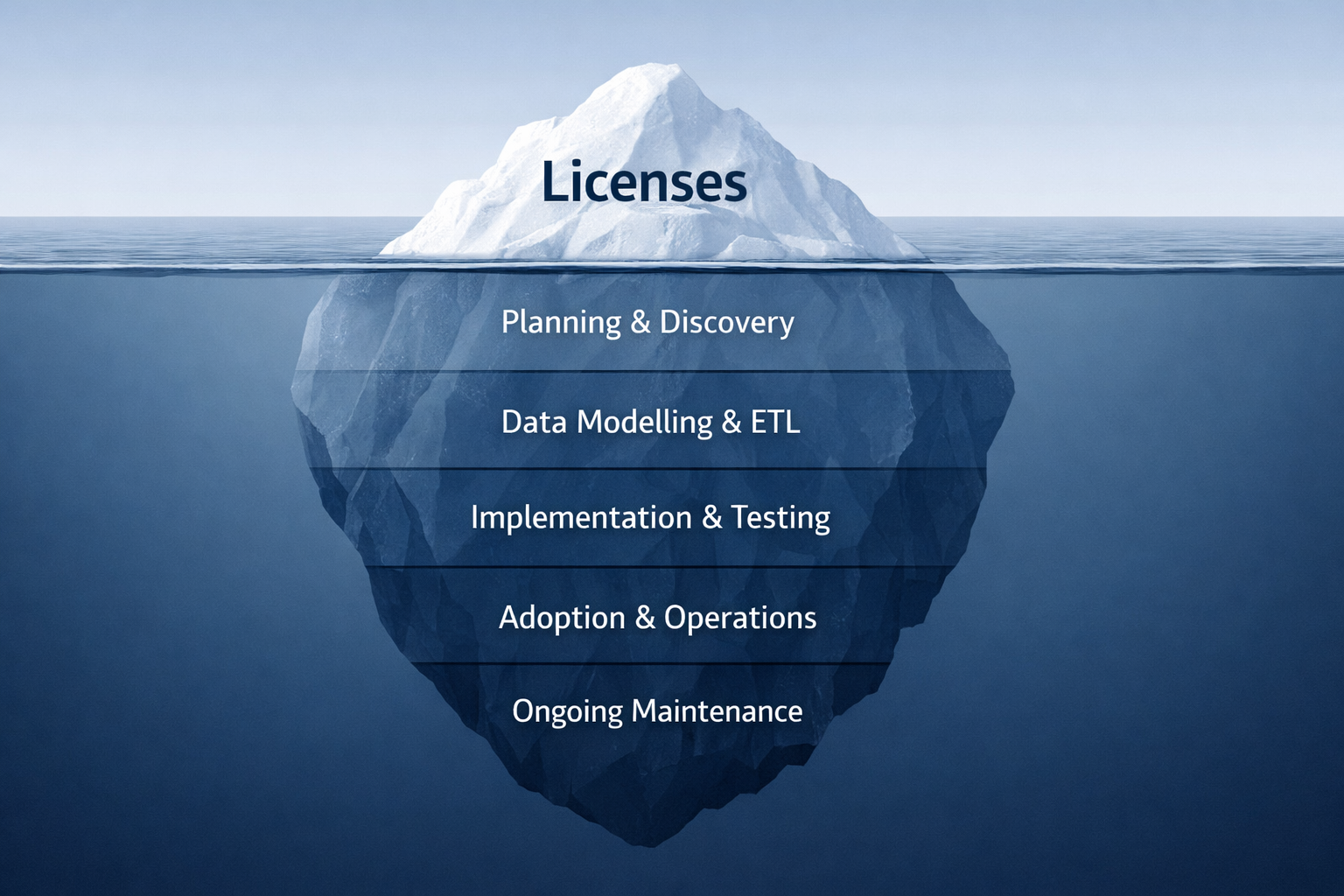
AI-enabled analytics introduces new cost patterns. Transparent usage and controlled growth help mid-sized organisations avoid surprises.
Shared datasets, reused models, and fewer duplicated reports support this goal. Simpler solutions often prove easier to maintain and explain internally.
What This Means Going Into 2026
Looking at recent years and current trends, BI in 2026 has a clear profile. Analytics increasingly operates as part of the data and AI platform. Cloud-based solutions dominate new initiatives. Governance and semantic consistency determine how far analytics can grow. For Polish mid-sized companies, the opportunity lies in using these patterns with care. Focus on trust, clarity, and gradual development tends to deliver more value than rapid expansion driven by new features.


Contact
Take your business to the next level with transparent business reporting
Choose a responsible partner with extensive experience who will provide real support for your team.