If you run a manufacturing operation and already use Business Intelligence, you probably feel one thing: you have data, but it still reacts too late. Your reporting environment gives structure and transparency, yet many situations on the shop floor develop gradually and become visible only after they have already influenced output, cost, or quality. The information exists, but the response often comes after the moment when a small correction would have been enough. In most manufacturing companies, the difficulty is the way data is connected to daily operations. By the time something is clearly visible in a report, the impact is already real. Adding AI to an existing BI environment starts to make sense when it improves this timing. Below are five ways manufacturing companies use AI inside their Business Intelligence systems to gain earlier visibility and more stable operations.
Table of Contents
1. Detecting Production Deviations Before They Escalate
On production lines, changes usually happen quietly. A cycle takes a bit longer, micro-stops show up more often, or a machine starts using slightly more energy. These signals are easy to miss in day-to-day work, and they become visible only when a weekly report shows lower output or rising costs. At that point, fixing the issue takes longer and puts more pressure on the team.
AI helps catch these trends much earlier and gives people better control over the process. Models built on sensor data, PLCs, energy meters and MES logs learn what “normal” looks like for each line. When the behaviour moves away from this pattern, the system simply raises an alert. Nothing complicated, just clear information that something needs attention.
Industry analyses show that predictive monitoring can reduce unplanned downtime by 20–50%. The effect is even stronger when these alerts are available directly in BI dashboards, because managers see them the same day and can react without waiting for another reporting cycle. It keeps the team focused on improving production, not on looking for the source of last week’s deviations. A small, early signal often prevents a much bigger problem later, and AI makes those signals visible exactly when they matter.
2. Improving Capacity Planning
In many factories the planning team works hard, but the tools they use often hold them back. Imagine a situation where the forecast was built on a two-year-old pattern, even though the company had already switched to shorter runs, a wider product mix and tighter customer deadlines. The planners knew the model wasn’t keeping up, yet they had no better way to predict how the next few weeks would look.
AI helps because it connects the dots that people see, but rarely have time to quantify. It looks at historical orders, the way product variants behave during busy seasons, how shifts perform on specific lines and how maintenance windows affect throughput. Benchmark data from intelligent factories shows that companies implementing AI-supported planning and analytics reported substantial improvements in productivity and schedule adherence. Facilities recognised by the global “smart factory” networks attribute much of the gain not to investments in new machines, but to better planning and coordination driven by data and AI.
When planners see forecasts next to real execution in BI dashboards, the feedback loop strengthens. They immediately learn where the plan was too optimistic and where it was conservative. Over time the forecast becomes more reliable, capacity is used in a more balanced way, and customers feel the difference because deliveries stop slipping without warning.

3. Understanding Causes of Small Losses
Large breakdowns are visible and generally handled. Smaller losses are far more dangerous: short interruptions, minor delays in material supply, slightly prolonged changeovers, and repeated quality rework. Individually, they seem negligible; but cumulatively, they can wipe out a significant fraction of daily production.
AI excels at revealing patterns in noisy data. By correlating machine logs, production cycles, energy consumption, maintenance records and quality data, it can uncover scenarios that consistently precede performance drops. In multiple research cases, AI-powered BI has helped companies score reductions in downtime, cost savings, and sharper awareness of where inefficiencies accumulate.
When companies embed these insights into BI dashboards, they transform vague hunches about “we lose too much during that shift” into observable, measurable phenomena. Discussions shift away from guesses into data-backed analysis.
4. Making Data Accessible
A persistent barrier in many mid-size manufacturing companies is that data remains trapped in dashboards or spreadsheets accessible only to analysts or IT/BI people. Executives, shift supervisors or engineers often rely on memory, intuition or delayed reports. AI changes that by enabling natural-language interfaces: managers can ask the system questions like “Which line had the highest downtime last week?” or “What shift caused the most scrap this month?” and receive near-instant visualizations or explanations.
Research on AI-powered BI platforms shows that systems combining advanced analytics with user-friendly interfaces drive wider data adoption: more people consult data, decisions become more fact-based, and response times shorten. In effect, AI becomes an interpreter, by transforming raw operational data into clear insights in the language managers already speak.
Why AI + BI Together Works Better Than Either Alone
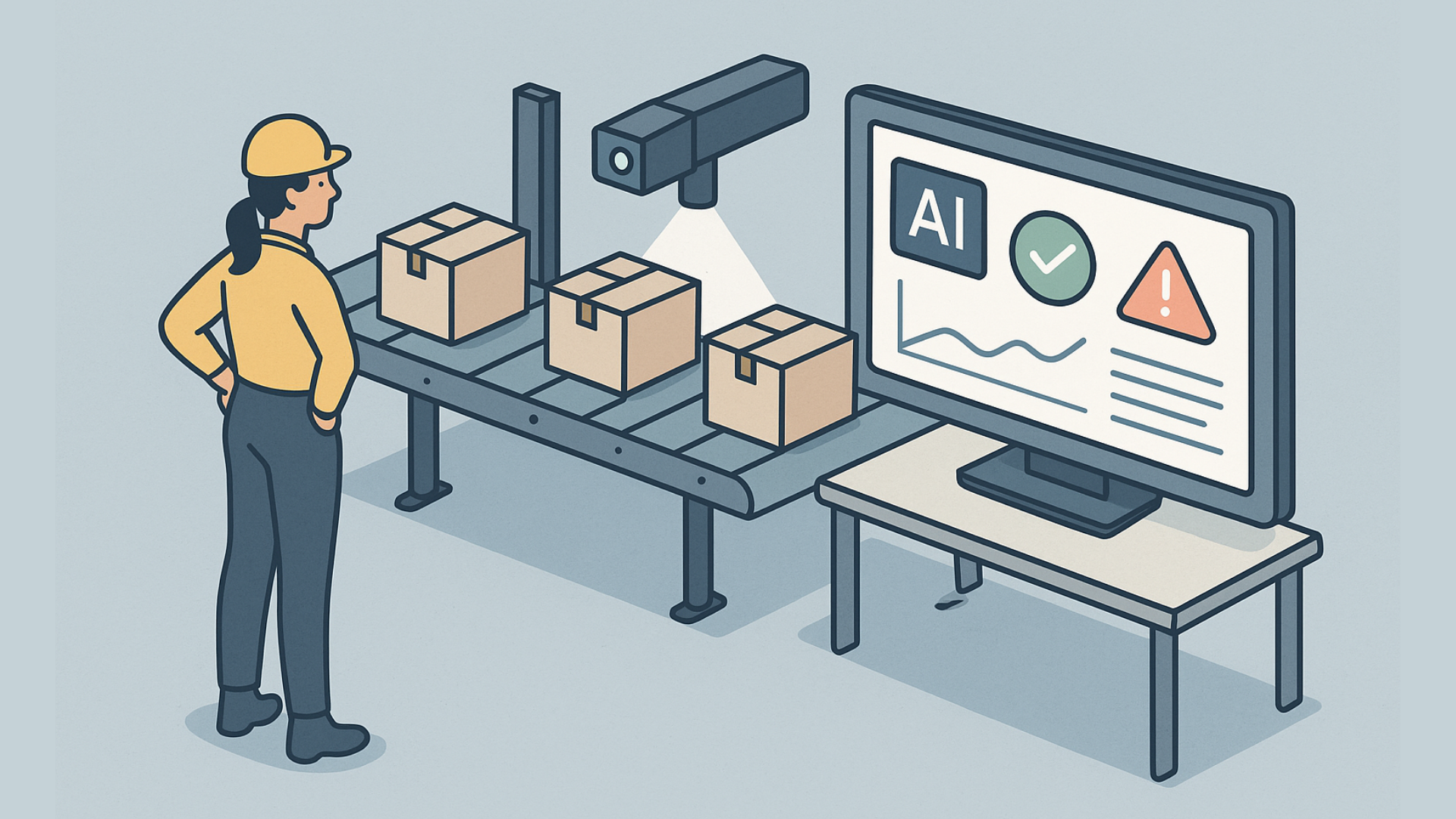
AI used on its own often becomes an isolated tool. It generates predictions, but without the business context and everyday routines built around BI, those insights tend to sit on the side. Traditional BI has the opposite limitation: it organises and explains data well, yet it mostly reflects what people already see happening on the shop floor. When AI supports BI, the two technologies naturally complement each other. AI points out deviations, patterns and risks that are impossible to track manually. BI gives these findings a place in the daily workflow, presenting them in a clear and shared form so teams can act on them immediately. Companies using this combined approach see improvements across maintenance, planning, quality and operations.
Recent review studies show how strong this effect can be: facilities using AI-enhanced BI reported around 45% less downtime, nearly 40% faster production and a noticeable increase in product quality.
For manufacturing organisations aiming for stable growth and more predictable output, adding AI to existing BI systems is a practical step forward. It strengthens the tools people already use, instead of creating another layer they need to manage.
AI is already finding a place in day-to-day manufacturing analytics as a practical extension of existing BI practices. For manufacturers working with operational data today, this direction offers a realistic way to improve visibility and decision-making without adding unnecessary complexity.
If you want to explore how you could support your team’s work, we can review your current setup and outline a few practical options. A short discussion is usually enough to understand where improvements would bring the most value and how to introduce them without disrupting the rhythm of your operations. Book your free consultation with our expert today!


Contact
Take your business to the next level with transparent business reporting
Choose a responsible partner with extensive experience who will provide real support for your team.