Now that 2026 is well underway, this is an appropriate time to take a broader view of the Business Intelligence market. Which platforms are currently setting the direction? Where are the largest vendors concentrating their investments? And which developments are most likely to influence BI decisions in the coming months?
In this article, we examine current market dynamics and outline how the leading BI providers are evolving.
This piece stays close to what the vendors have already published in official public release notes, articles and announcements. The goal is to translate those dates into practical planning implications for SMEs using BI.
Table of Contents
Microsoft
Microsoft has set concrete deadlines for key Power BI changes, and for SMEs this is mainly a planning topic.
The official Power BI blog announcement states that Power BI Q&A is being retired in December 2026, with Copilot becoming the default path for natural-language analysis. If Q&A visuals are still used in your reports, it is worth checking that now. In many SME environments, these elements were added over time and are not fully documented, so early review helps avoid rushed fixes later.
The shift to PBIR is another important change. Microsoft’s PBIR announcement says Power BI Desktop is expected to default to PBIR in March 2026, and PBIR will become the standard format after general availability. For teams using PBIX-based source control or deployment flows, this affects daily operations and release processes. A small pilot first is usually the safest approach.
There is also a near-term date to track: Microsoft’s January 2026 “What’s New” page states that support ends on April 13, 2026, while the component remains functional but unsupported. Even if it still runs, unsupported components increase maintenance risk. For SMEs, this is a good moment to identify old SharePoint embeds and plan replacements in a controlled way.

Google (Looker)
Recent Looker release notes show Google expanding Gemini in Looker and adding more administrative controls for how conversational outputs and shared results are handled.
Conversational Analytics is generally available for Looker instances on Looker 25.18+ (with Gemini in Looker enabled. In February 2026, Google added “Show reasoning” to Conversational Analytics, which provides a plain-text explanation of how a question was interpreted. In the February 17, 2026 update, Google added new permission controls that let admins limit which users can send or schedule deliveries that include complete (“all”) result sets. The same release also expanded certification features, with clearer indicators when dashboards or analyses rely on self-service Explore content that hasn’t been certified.
For SMEs, these changes can reduce the time needed to get answers, while making role design and content trust markers more relevant in day-to-day reporting. Practical steps are to confirm the instance is on 25.18+ version, define which user groups can use conversational features, review delivery/export permissions (including new permission controls), and use certification for key dashboards and Explores to reduce inconsistent interpretation.
There is also one deadline to note: Looker Mobile (Legacy) is deprecated on March 1, 2026. If any teams still use it, this is the right time to complete migration to a supported mobile path.
Amazon
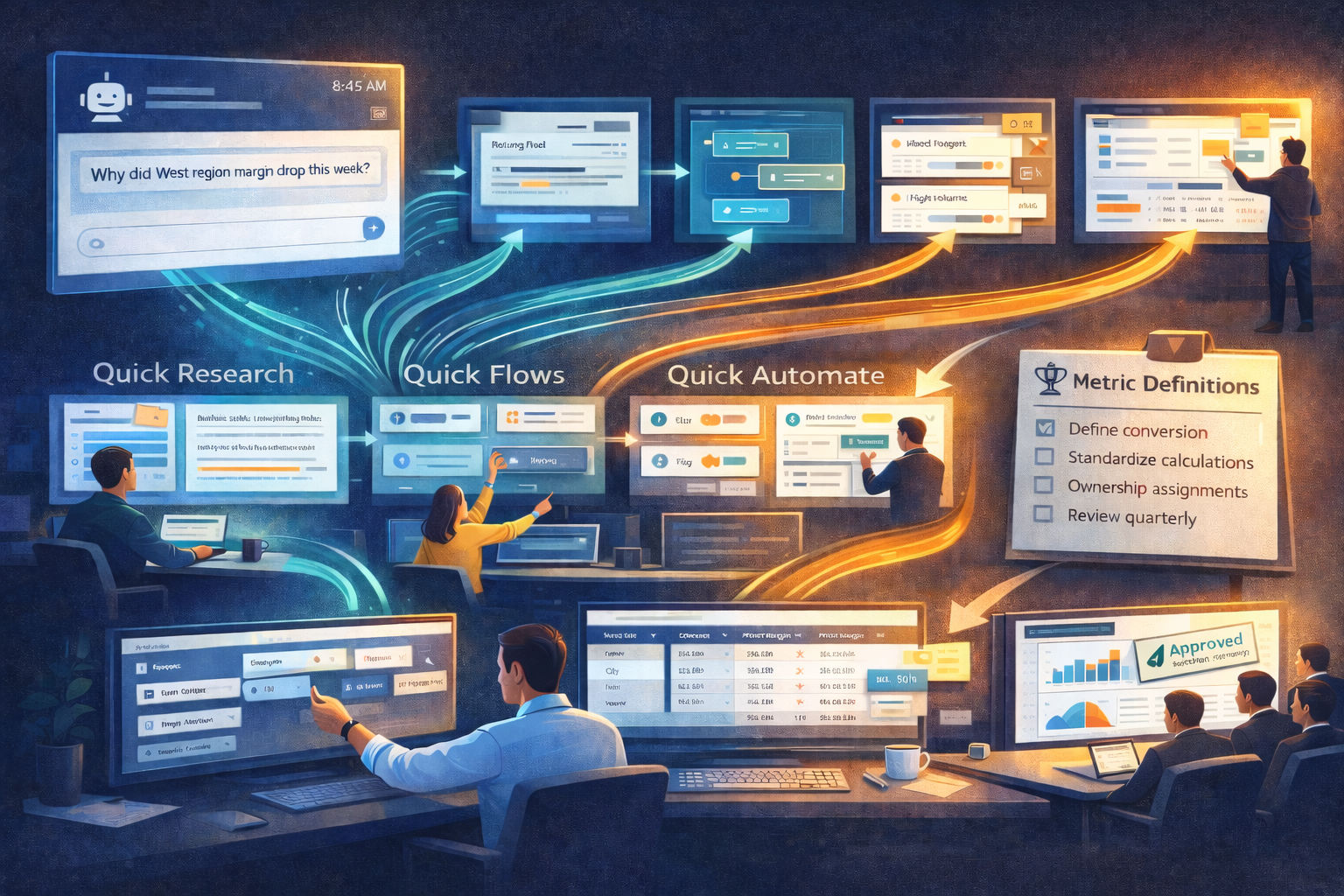
In October 2025, AWS renamed QuickSight to Amazon Quick Suite and introduced a new chat-first interface. From that entry point, users can access AI capabilities such as Quick Research, Quick Flows, Quick Automate, and Quick Index.
A chat-based start changes daily reporting behavior. Business users can ask questions directly in the tool, which increases speed in early analysis. This also puts more attention on metric definitions and access setup, because inconsistencies show up quickly when usage expands.
In January 2026, AWS added reader-side editing in dashboards. Users can modify fields, aggregations, and formatting in tables and pivot tables without requesting updates from report authors. This helps reduce operational backlog and allows analytics teams to spend more time on model quality and decision support.
Teams should also define reporting standards for review meetings: which view is approved for decision-making, and which view is used for individual exploration. Clear rules at this stage prevent confusion later.
Strategy (MicroStrategy)
In June 2025, Strategy announced general availability of Strategy Mosaic, describing it as a universal intelligence layer designed to keep metrics consistent and governed across multiple data sources.
The January 2026 Strategy One updates continued that direction. The release introduced Mosaic Sentinel for governance visibility and model linking for relationships across models. The same update also set a timeline for Narrowcast Server support retirement in June 2026, which is relevant for teams still relying on legacy distribution setups.
The overall direction is clear: Strategy is prioritizing a semantic-layer approach. In day-to-day operations, this puts focus on ownership. Teams need clear accountability for metric definitions and clear rules for how those definitions are applied across reports. When ownership is defined early, the semantic layer improves consistency and reduces reporting disputes.
What this means for 2026 planning
Across vendors, the same direction is visible: AI-assisted analysis is becoming the standard user experience, and legacy components are being retired on fixed dates. For 2026 planning, the main risk is weak execution around ownership, governance, and migration timing.
A practical plan starts with visibility. Teams need a clear map of which reports, dashboards, embeds, and mobile paths are still in active use. From there, it becomes much easier to prioritise changes and avoid deadline-driven disruptions. At the same time, business definitions should have explicit owners. As conversational and self-service usage grows, unclear metric ownership quickly turns into conflicting answers in review meetings.
Planning should also separate official reporting views from personal exploratory views. This keeps flexibility for users while preserving consistency in management reporting. Migration work is safest when phased across the year rather than concentrated in one release window, especially where legacy dependencies are still present.
In short, reporting stability in 2026 will depend less on tool selection and more on operational discipline: clear definitions, clear accountability, and early migration planning. If you want a broader context before turning this into a roadmap, our BI Trends 2026 overview adds a vendor-agnostic perspective.


Contact
Take your business to the next level with transparent business reporting
Choose a responsible partner with extensive experience who will provide real support for your team.