
A growing company sooner or later reaches a point where conversations, spreadsheets and individual reports are no longer enough for calm management. The number of customers, orders, employees, processes and systems increases, and so does the number of decisions that need to be made from the same data. This applies both to companies that scaled according to a deliberate plan and to those that developed step by step as the market, customers and new opportunities appeared.
At that point, questions appear that intuition no longer answers. Was this month better than the previous one if margin dropped but revenue went up? Which customer segment actually earns money? Is the service team keeping pace? Where does the gap between the sales report and the accounting books come from? The board asks for one number and gets three different values from three different departments. Each looks correct and each is defended by its author.
This is the moment when the company starts to need KPIs understood as a shared language of decisions. A language in which the people running the company talk about progress, risk and priorities based on the same numbers, not on their own private reports. This article explains what KPIs are, what they are for, how to choose them for different types of company, how to calculate them, where the data should come from, and how a data warehouse and a BI system can help keep these measures consistent. With no ready-made list of “the most important KPIs for every company”, because no such list exists, and with pointers to solid sources at the end.
Table of Contents
What a KPI is
KPI stands for Key Performance Indicator. The simplest way to think of it is as a chosen, measurable indicator of progress against a previously defined goal. The definition used by KPI.org / Balanced Scorecard Institute emphasises four traits: the indicator must be tied to a goal, must show progress, must be understandable to the people making decisions, and must be calculated in a repeatable way so that comparisons across time mean something.
It is worth separating two concepts that companies often confuse:
- A performance measure is a number describing what the company does: how much it sells, how well it serves customers, what the quality is, how many people it employs. The State of Washington Performance Measure Guide describes such measures as data that answer questions like: how much are we doing, how well are we doing it, and is the recipient of our work better off because of it. The measure itself is information; it does not yet decide that this is the indicator a board will rely on.
- A KPI is a measure that has been consciously selected as key to managing a particular area, because it is connected to a goal, a decision and a responsibility to react.
In other words, every KPI is a measure, but not every measure should be a KPI. The difference comes from how the company uses a given number in management. The same Washington guide stresses that measurement should support learning and the improvement of results. Tying measures too mechanically to incentives quickly directs the organisation’s attention to the wrong activities.
In practice a good KPI passes a simple test: does this number help someone make a decision, set a priority, react to a deviation or assess progress against a goal? If the answer is no, what you have is a measure that can serve analysis but does not play the role of a management indicator.
KPI.org also distinguishes types of measures that are useful to keep apart in management: input measures (e.g. headcount, budget), process measures (e.g. cycle time), direct output measures (e.g. number of shipped orders), outcome measures for the recipient (e.g. customer satisfaction), and leading and lagging indicators. Lagging indicators, such as monthly margin, tell you what has already happened. Leading indicators, such as the sales pipeline or first response time, tell you what to expect. The board of a company that wants to scale usually needs both.
Why KPIs matter in running a company
The most important function of KPIs in a growing company is to bring different people to the same table with the same information. Where there are shared measures, the board discussion revolves around decisions, not around the question of “whose number is the true one”.
KPI.org points to three deeply practical roles of KPIs: improvement of results, data-based decisions, and connecting the daily work of teams to broader company goals. The last point is particularly important for the owner. When the sales team, the warehouse, finance and customer service do not see indicators connected to the same goal, each starts to optimise its own piece. The result is sales that break records while the warehouse cannot keep up and customers wait two weeks for goods.
Practical benefits of well-set KPIs, visible in companies scaling from the inside:
- The board sees the same numbers as the people responsible for delivery, and does not have to settle which version is “the real one”.
- Deviations can be caught earlier, before they turn into a problem visible in the monthly result.
- Responsibility for an outcome can be tied to a person or a role in the company, not to a department as an abstract entity.
- Setting priorities stops being a game of storytelling. The argument “I think this is important” gives way to the argument “indicator X has been falling for three weeks and is not responding to the actions taken so far”.
On the other hand, KPIs without shared definitions can, in the same company, create fights over numbers instead of helping. If a growing company rolls out indicators without agreeing what exactly is being counted, over what period and from which system, board discussions quickly come down to reconciling numbers rather than agreeing on decisions. dbt Labs writes about this phenomenon among others in their materials on the semantic layer and central metric definitions (Build, centralize, and deliver consistent metrics with the dbt Semantic Layer).
A historical reference point on linking measures to strategy is the Balanced Scorecard by Robert Kaplan and David Norton, published in Harvard Business Review in 1992, and later developed in the book The Balanced Scorecard: Translating Strategy into Action (Harvard Business School Press, 1996). The authors showed that financial indicators alone are not enough to run a company: they should be complemented by measures of the customer, of internal ways of working, and of organisational learning and growth. For someone running a growing company, the conclusion translates directly into daily work. The financial result alone tells you what happened. To understand why, and what to do next, you need additional measures that stay close to the strategy.
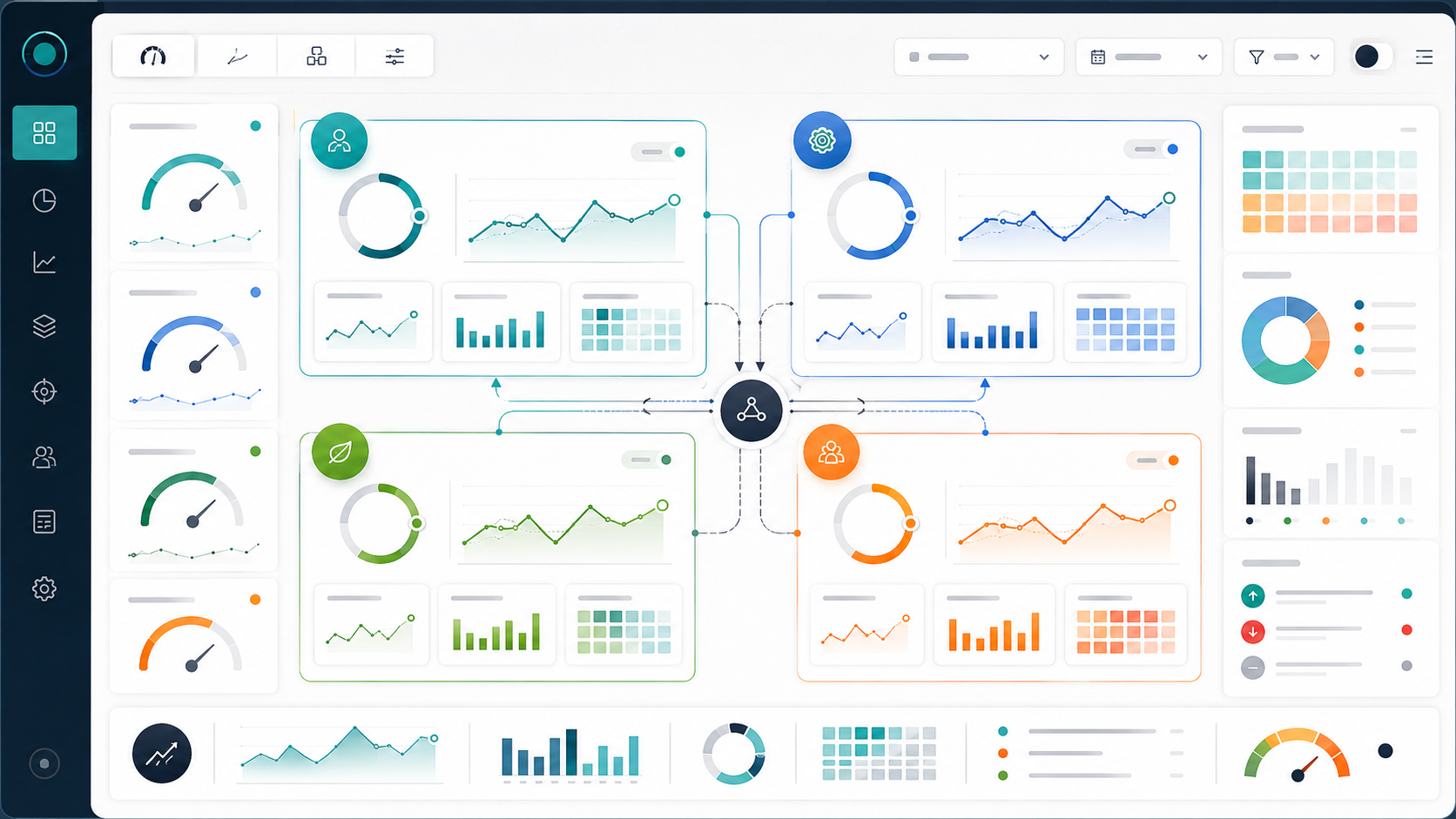
Choosing KPIs for different types of company
The most common mistake of companies that start to put their indicators in order is to copy a “universal list of the most important KPIs”. Such lists circulating online usually come from different business contexts and, taken together, produce a set of measures with no internal logic. KPI.org explicitly notes that KPI examples are not a ready-made list to copy. Effective indicators must follow from the company’s strategy, goals and situation.
A more sensible approach starts with the questions a leader should answer for themselves before choosing the first indicator:
- What goal do we want to reach in the coming period? Growth, profitability, shorter lead time, customer retention, putting service in order.
- What decision should be made on the basis of the indicator? An investment, a change in priorities, a management intervention, a change in process.
- Who can actually influence the result? An indicator without an owner responsible for the work in that area quickly turns into a reporting totem.
- How quickly do we need to see a deviation? Every day, once a week, once a month, once a quarter.
- Which system holds the closest record of the event we want to measure? Sales, invoice, shipment, work order, customer contact.
After that conversation it is easier to pick a few KPIs that match the business model and area of responsibility. The examples below are best treated as a map for a conversation with the team, not as a ready-made list to roll out.
Retail or e-commerce. Natural indicators include orders, net sales, margin, conversion, average basket value, returns, stock availability and on-time shipments. Data usually comes from the online store, the point-of-sale (POS) system, the invoicing system or ERP, the warehouse system and marketing tools. The terms ERP (Enterprise Resource Planning, usually the system that handles accounting and logistics, among other things) and WMS (warehouse management system) are explained in more detail further on.
B2B project or subscription sales. Typical indicators here include pipeline (the total value of current sales opportunities), the number of opportunities, win rate (the share of won deals), contract value, sales cycle time, receivables, churn (the share of customers who leave in a given period) and customer retention. The main data sources are CRM (customer relationship management), an invoicing or finance system and, if the company provides post-sales support, a ticketing system.
Manufacturing. The key indicators are usually plan vs. actual, line throughput, downtime, defects, on-time orders, material consumption and quality. The data flows from ERP, from MES and SCADA (systems that support production work and collect data from the shop floor), from quality systems and from the warehouse. The ISA-95 standard, defined by the International Society of Automation, organises this picture by placing ERP at the level of business planning and MES and SCADA closer to the shop floor.
Logistics and warehousing. Natural measures include stock availability, turnover, picking accuracy, order lead time and shipping delays. The natural data source for warehouse work is WMS, supplemented by ERP and the store or POS system. Oracle defines WMS as a system that provides inventory visibility and manages fulfilment from the distribution centre to the store or customer. Which source is the “official one” for a particular indicator should follow from that indicator’s definition card; sometimes board reporting reaches into ERP or a data warehouse even though the original record of warehouse events is created in WMS.
Service, help desk and customer support. Indicators include the number of tickets, resolved tickets, backlog (the queue of unresolved cases), first response time, resolution time, CSAT (customer satisfaction score) and contact reasons. The main sources are a ticketing system (e.g. a help desk), CRM and surveys. Zendesk documents examples of such metrics and their formulas in its knowledge base.
Finance and controlling. Natural KPIs include revenue, margin, costs, receivables, payables, cash flow and the profitability of a customer, product or project. The data usually comes from accounting, ERP, invoicing and, if the company already has one, from a data warehouse. Inside ERP, the central register of financial entries is the general ledger, described for instance in the Microsoft Dynamics 365 Finance documentation.
HR and workforce planning. Indicators include headcount, turnover, absence, overtime, time utilisation and training. The data comes from an HRIS (a human resources information system), from a time-and-attendance system and from payroll. Oracle defines HRIS as a system that manages employee information and HR procedures, while ADP describes time-and-attendance systems as tools that collect hours worked through clocks, paper and electronic timesheets, kiosks or mobile apps.
Even if a company recognises itself in several of these areas at once, it should not try to roll out dozens of indicators at the start. It is more sensible to pick a few KPIs at the board level and a few KPIs at the level of each department, which together tell one coherent story about the company.
How to calculate KPIs so that they count the same way everywhere
The most common problem of a growing company does not come from KPIs being badly chosen. It comes from the fact that the same indicator calculated in two places gives two different values. It is enough to have a board meeting where sales shows revenue for March, finance gives a different number, and the person reporting to the bank has yet another one. Everyone is right, because everyone counted differently, but the company does not have one number it can rely on.
The answer is a KPI definition card. It is a simple document that, for each KPI, states how to calculate it, on which data and who is responsible for it. Templates of such a document have long existed in the public and health-care sectors. The Performance Measure Methodology Sheet Template prepared by the International City/County Management Association (ICMA) covers, among other things, the indicator’s name, owner, reason for collection, meaning, data source, formula, frequency, target and unit. The American CMS Measures Management System describes a measure specification as instructions for building an indicator, precise enough so that every implementation calculates the same thing in the same way.
Translated into an ordinary commercial company, a KPI definition card should contain at least:
| Element | What to record |
|---|---|
| Name | One business name (e.g. “gross margin per order”) and, if needed, a technical identifier. |
| Management purpose | Which decision or goal the indicator supports. |
| Formula | The formula, numerator and denominator, the aggregation method: sum, mean, median, percentage, running total. |
| Scope | Which entities, departments, products, countries, channels, customer types or statuses are included. |
| Period | Day, week, month, quarter, year; which date triggers inclusion: creation date, payment, invoice, shipment, closing. |
| Source system | Name of the system and the specific table, report or API. |
| Business owner | Person or role who approves the meaning of the definition. |
| Data owner | Person or role responsible for data quality and for explaining differences. |
| Refresh | How often the value is updated and at what hour it is ready for use. |
| Exceptions | Returns, cancellations, corrections, duplicates, test records, discounts, taxes, multiple currencies, incomplete data. |
| Target and thresholds | Target value, alert thresholds, tolerances, since when they apply. |
| Change history | Date of definition change, reason, approver, impact on comparability over time. |
The table looks formal, but in daily work it saves time for a simple reason: if anyone ever asks “where does this number come from”, the answer does not depend on the memory of the person who put the report together. It comes from a document that can be shown, corrected and versioned.
In practice it is more sensible to start with a few of the most important KPIs, describe them in this way, and only then add more. Trying to write definitions for every indicator in the company at once usually overloads the team and gets lost in daily work.
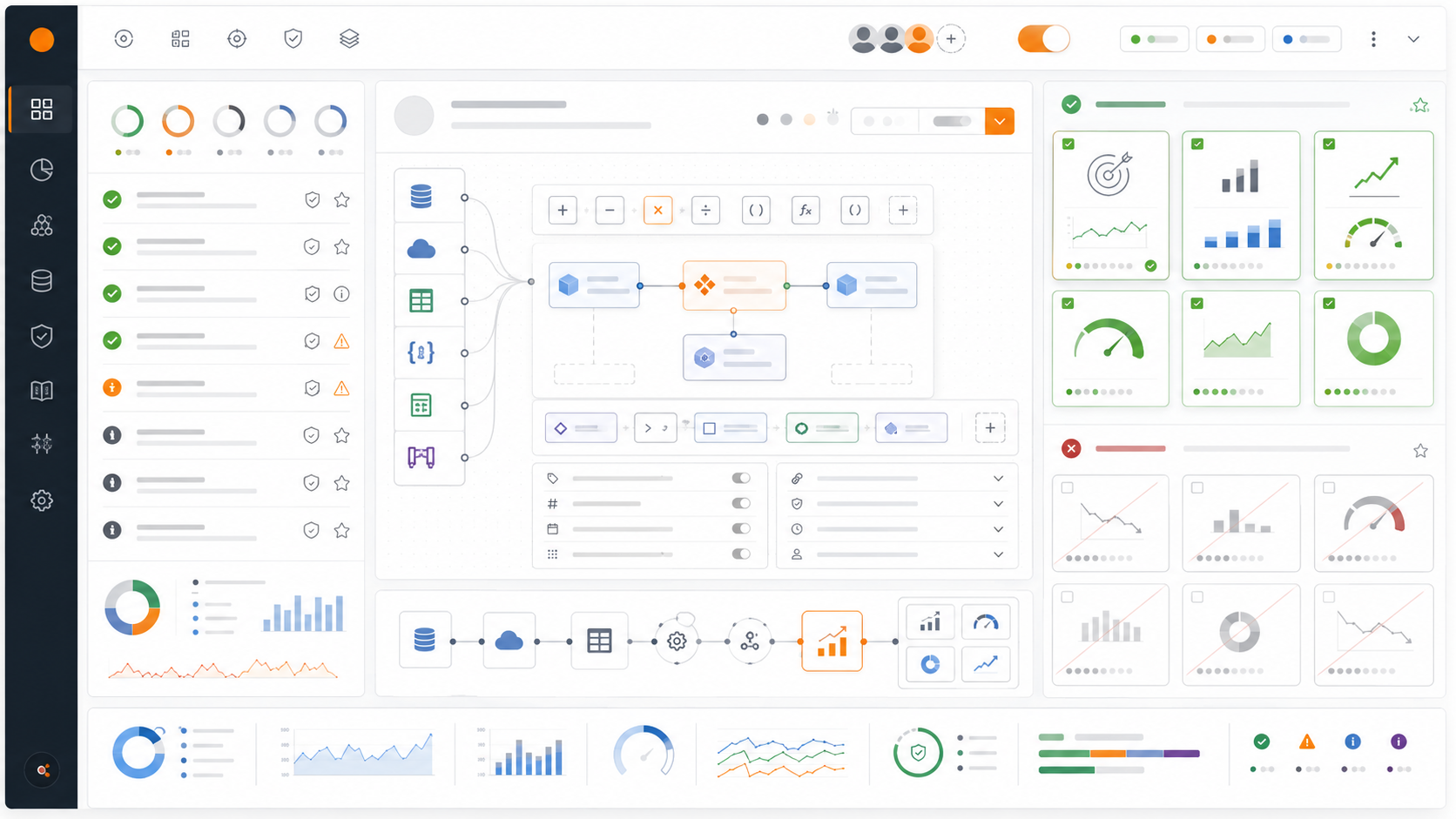
Where the data should come from
The definition card answers the question of how to calculate. The next question is from where. In a growing company a KPI usually has several possible sources, and the choice matters.
Sales values can be pulled from the store system, from CRM, from the invoicing system or from accounting. Each of these sources has its own logic. The store knows the order from the moment of clicking “buy”, CRM knows opportunities and contracts, the invoicing system knows the invoice, and accounting knows the final booked revenue after adjustments. These numbers may diverge for natural reasons, not because of an error.
The main types of source systems that feed KPIs in an average growing company:
- ERP (Enterprise Resource Planning). SAP defines ERP as a system that helps organise the company’s core processes, such as finance, HR, manufacturing, supply chain, sales and procurement, providing a unified view of activity. In practice, ERP is usually the main source of truth for finance, stock and invoicing.
- CRM (Customer Relationship Management). Salesforce defines CRM as a system for organising customer data, tracking interactions and managing relationships across sales, service, marketing and commerce. It is a natural source of sales indicators: pipeline, win rate, sales cycle time, customer retention.
- E-commerce and POS systems. Shopify’s documentation shows how to track order metrics for a chosen period in the store admin, including the number of orders and the number of ordered items. POS is the in-store sales system (software with a terminal), usually tied to the same sales logic.
- WMS (Warehouse Management System). Oracle describes WMS as a system that provides inventory visibility and manages order fulfilment from the distribution centre to the store or the customer. It is a natural source of indicators related to stock availability, picking and shipping.
- MES and SCADA. These are systems from the shop floor, described together with ERP in the ISA-95 standard. MES (Manufacturing Execution System) knows individual production orders; SCADA collects data directly from machines.
- Ticketing / help desk system. Zendesk documents typical ticket metrics, for example the number of tickets created, solved and unsolved, together with the formulas.
- HRIS, time-and-attendance and payroll. Oracle defines HRIS as an employee information system, and ADP describes a time-and-attendance system as a tool that collects hours and is connected to payroll.
- Data warehouse. IBM describes a data warehouse as a system that integrates data from many sources; the data goes through an ETL process that cleans and structures it before analytical use.
The choice of source system is not neutral for an indicator. Revenue counted “by order” will show different values than revenue counted “by invoice” or “by booked payment”. The definition card should clearly indicate which moment and which system is the point of truth for a given KPI. Without that, even correct data from each of the systems can produce different values for the same indicator, and the company finds it hard to decide which is “the right one”.
Why the same KPI can produce different values
The most important practical observation for someone running a growing company is this: differences in KPIs between systems are the norm when the company does not have a single definition layer and shared dictionaries. They usually do not come from an error or bad intent — they come from the fact that each system looks at the company from a different angle.
The most common causes of differences worth checking before disputes about “the right number” begin:
- Different event dates. Order date, payment date, invoice date, shipment date, close date. Sales usually looks at orders, finance at invoices, the warehouse at shipments.
- Different record statuses. Test, cancelled, returned, on-hold, draft orders. If one report counts everything and another skips cancelled ones, they will differ.
- Different scopes. The whole business, a chosen company, a branch, country, channel, customer segment, warehouse. The same indicator can be counted “at the group level” or “at the parent company level”, and the difference is not an error.
- Different value definitions. Gross vs. net, with or without tax, with or without discounts, before or after corrections.
- Different customer and product identifiers. The same customer can be different in CRM, ERP, the store and WMS if each system stores them under a different code.
- Different refresh moments. Daily report, near-real-time data, values from a month ago. The board looked at different reports at different moments and sees different numbers.
- Different currency and conversion rules.
- Different permission filters. The same dashboard shown to two people can yield different values if each one sees a different slice of the data.
- Different aggregations. Sum of transactions, value of unique orders, average per customer, average per day. Everything sounds like “average sales”, yet each means something different.
For the board, the conclusion is pragmatic. If sales, finance and the delivery teams see different values for the same KPI, decisions rest on a local version of the data, not on a shared definition. Inconsistent KPIs complicate period comparisons, bonus payouts, stock planning, customer profitability assessment, month-end close, and conversations with investors or a bank.
dbt Labs, in its material on the semantic layer (Build, centralize, and deliver consistent metrics with the dbt Semantic Layer), describes this problem directly: different calculations of critical measures can lead to disputes about which version of reality is correct, weaken trust in data and make decisions harder. In the everyday language of a manager, the same phenomenon sounds simpler: “meetings where half the time is spent on agreeing whose number is the right one”.

How a data warehouse, master data, governance and BI help
The question of how to make the same KPI produce the same value regardless of who asks and where they ask is answered, in data management, by several elements. They are not interchangeable; together they form a package whose individual elements rarely work in isolation.
A data warehouse is a central place where data from various company systems is collected, organised and prepared for analysis. IBM describes it as a system that integrates data from many sources: transactional databases, business systems and CRM platforms; the data usually goes through an ETL process (extract, transform, load) that cleans and organises it before loading. The warehouse offloads the source systems from heavy reporting queries, records historical changes (for example how a customer’s status changed over time) and lets you compare periods even when the source systems have changed their data structure.
Master data management (MDM) answers the question of what, in fact, a customer, product, branch, warehouse, supplier or employee is. IBM describes MDM as an approach that consolidates key company data and reduces fragmentation, duplicates and inconsistencies. Without it, the company may talk about “the same customer” while ERP, CRM and the store each have them stored under three different codes, and a report combining the three systems treats them as three different customers.
Data governance is the set of rules and responsibilities through which definitions are written, approved, changed and maintained consciously. IBM notes that governance can create a so-called single source of truth — one shared source of truth for the organisation — by centralising definitions and metadata in a data catalogue. In management practice, governance ensures that a KPI definition does not disappear together with the person who created it.
The metrics layer (semantic layer / metrics layer) is the practical idea of keeping indicator formulas in one place, while different tools (BI, spreadsheets, analytical notebooks, board reports) query the same definitions. dbt Labs describes this approach, among other places, in Unify metrics and accelerate analytics with dbt Semantic Layer. For the board this means roughly: if the margin formula is the same in Power BI, in the financial controller’s spreadsheet and in the management app, because everything reaches for one definition, fights over numbers are rarer.
BI (Business Intelligence) is the set of tools through which data becomes visible to the people running the company. Microsoft, in the Power BI documentation, describes scorecards and goals as a way to curate goals and track their delivery in a single view, with accountability, team alignment and visibility of initiatives. A value on a scorecard refreshes as often as the underlying data model refreshes. This matters because BI by itself does not fix data. It shows what it receives.
The most important takeaway: a data warehouse and BI do not create KPI consistency on their own. Consistency is created by shared definitions, master data, governance and a deliberately designed data layer. The warehouse and BI are the tools that make these agreements repeatable and comparable over time.
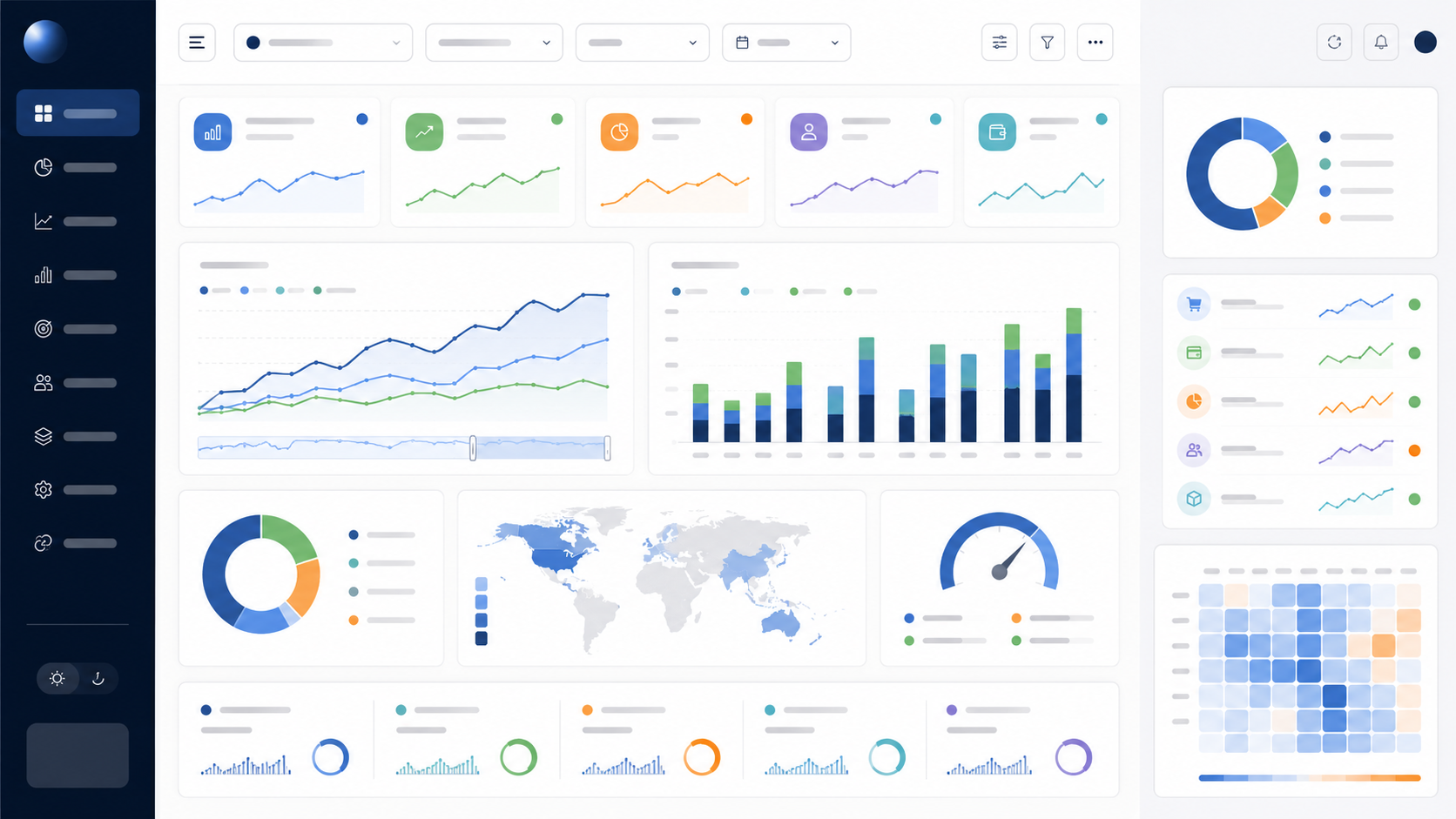
How to start in practice
For someone running a growing company that does not yet have a formal KPI management system, a sensible sequence usually looks like this:
- Start with a few business goals that genuinely matter for the next six months. Not with a list of “all areas of the company”. Goals usually let the company itself recognise which decisions are critical.
- For each goal, name the decisions the board wants to be able to make faster and with more confidence. This leads to the question of which indicators are really needed and which are convenient but unused.
- Pick a small number of KPIs that together tell one coherent story about the company. It is better to start with a few indicators at board level and a few at the level of each department and to expand the list carefully than to roll out dozens of indicators that no one will maintain afterwards.
- Write a definition card for each KPI, following the schema described earlier. Without this, further technical work hits a wall.
- Indicate which source system the data comes from. If a given indicator can be calculated from several systems, decide which source is the official one for the board.
- Designate business owners and data owners. The business owner approves what the indicator means. The data owner is responsible for ensuring the number is correct and explains differences when they appear.
- Test whether the same KPIs calculated from different systems produce the expected result. If they differ, work out why: date, status, scope, value definition, identifier, aggregation, refresh, currency, permissions.
- Only then make decisions about tools: data warehouse, metrics layer, BI. A tool decision after the definitions are in order is usually calmer and leads to better-chosen tools, because you already know what they have to support.
This sequence does not require the company to buy tools first and then find a use for them. It requires it to name its goals and decisions first, and then choose indicators and technology to support those decisions.
A practical take on a similar rhythm of work on indicators can be found, among others, in Stacey Barr’s book Practical Performance Measurement: Using the PuMP Blueprint for Fast, Easy and Engaging KPIs, which describes how to build measures that are understandable and useful to managers, not just formally correct.
A short summary for the board
KPIs are a management tool when they are well defined, calculated from reliable data and understood in the same way across different parts of the company. Without these conditions, they remain a set of charts that look like a management report but are not one.
A growing company that has moved into a larger scale needs a shared language of decisions. KPIs are a pragmatic form of that language and work well in management. A definition card, agreement on the data source and the owner, and a deliberate understanding of why the same indicator can diverge between systems, deliver the most value. A data warehouse, master data, governance, a metrics layer and BI become valuable once those agreements are in place.
In such a setup, the board receives a tool for running the company. Without it, even a very nicely designed dashboard mostly shows inconsistent data.
Further reading
Books that help owners and managers organise their thinking about KPIs, measures and data-driven management:
- Robert S. Kaplan, David P. Norton, The Balanced Scorecard: Translating Strategy into Action, Harvard Business School Press, 1996. A classic on linking measures to strategy across several perspectives.
- David Parmenter, Key Performance Indicators: Developing, Implementing, and Using Winning KPIs, 4th ed., Wiley, 2019. A guide to the process of designing KPIs and to accountability for measurement.
- Stacey Barr, Practical Performance Measurement: Using the PuMP Blueprint for Fast, Easy and Engaging KPIs. A practical guide to choosing and implementing measures that managers can understand.
- John Doerr, Measure What Matters, Penguin Publishing Group, 2018. On OKRs and the management rhythm built on measurable outcomes.
- Ralph Kimball, Margy Ross, The Data Warehouse Toolkit: The Definitive Guide to Dimensional Modeling, 3rd ed., Wiley, 2013. A classic on modelling data for reporting and BI.
- DAMA International, DAMA-DMBOK: Data Management Body of Knowledge, 2nd edition. A framework for data governance, master data, data quality and enterprise data management.
Sources
- KPI.org / Balanced Scorecard Institute, What is a Key Performance Indicator (KPI)?
- Washington State, Performance Measure Guide
- Robert S. Kaplan, David P. Norton, The Balanced Scorecard — Measures that Drive Performance, Harvard Business Review, January–February 1992.
- ICMA, Performance Measure Methodology Sheet Template
- CMS Measures Management System, Measure Specification
- IBM, What Is a Data Warehouse?
- IBM, What is Data Governance?
- IBM, What is Master Data Management?
- Microsoft Learn, Get started with goals in Power BI
- dbt Labs, Build, centralize, and deliver consistent metrics with the dbt Semantic Layer
- dbt Labs, Unify metrics and accelerate analytics with dbt Semantic Layer
- SAP, What is ERP?
- Salesforce, What is a CRM system?
- Microsoft Learn, General ledger overview — Dynamics 365 Finance
- Shopify Help Center, Viewing order analytics
- Oracle, What Is a Warehouse Management System (WMS)?
- ISA, ISA-95 Standard: Enterprise-Control System Integration
- Zendesk Help, Metrics and attributes for Zendesk Support
- Oracle, What Is HRIS?
- ADP, Time & attendance solutions for businesses